
Someone sneezes in the office on Park Avenue in the middle of June. It's my first real summer in New York, the junior-to-senior-year internship I had been waiting for. The room of analysts speaks the answer in unison—Bless you. Bless you. Bless you.
I don't.
The silence that follows is small but heavy, like a coin placed on my desk. It doesn't accuse. It just sits there, catching the light, waiting to be picked up. By the third office sneeze that week, I begin to say it back. Quick, polite, bloodless. The air closes neatly over where I'd been silent.
Under the fluorescent lights of the building, even language feels like dress code. Neutral colors. No perfume. “Bless you,” as a kind of company policy—something everyone does without thinking, the same way everyone hovers outside conference rooms until the calendar confirms the room is theirs. I copy: how to laugh at jokes I don’t find funny. How to say “I’m good, how are you?” in the elevator, then step out before anyone answers. How to eat lunch alone without looking lonely.
At home, in the satellite city west of Cairo where I grew up, a response to a sneeze is not ornamental. It’s a call. The sneezer speaks first and someone always answers.
Elhamdulillah (praise be to God) is what I say after I sneeze. It's a word with many lives. We say it after relief and after loss, when we stand up from a fall, when a phone call ends better than we feared. We say it for food and survival and for the fact of still being here. I cannot list all the moments to which it belongs.
The room replies: Yerhamkom Allah. May God have mercy on you.
Then it's my turn again: Yerhamna w yerhamkom. May He have mercy on us and on you. Mercy here moves in a circle. It requires another body. Another voice. I am inside the us it creates.
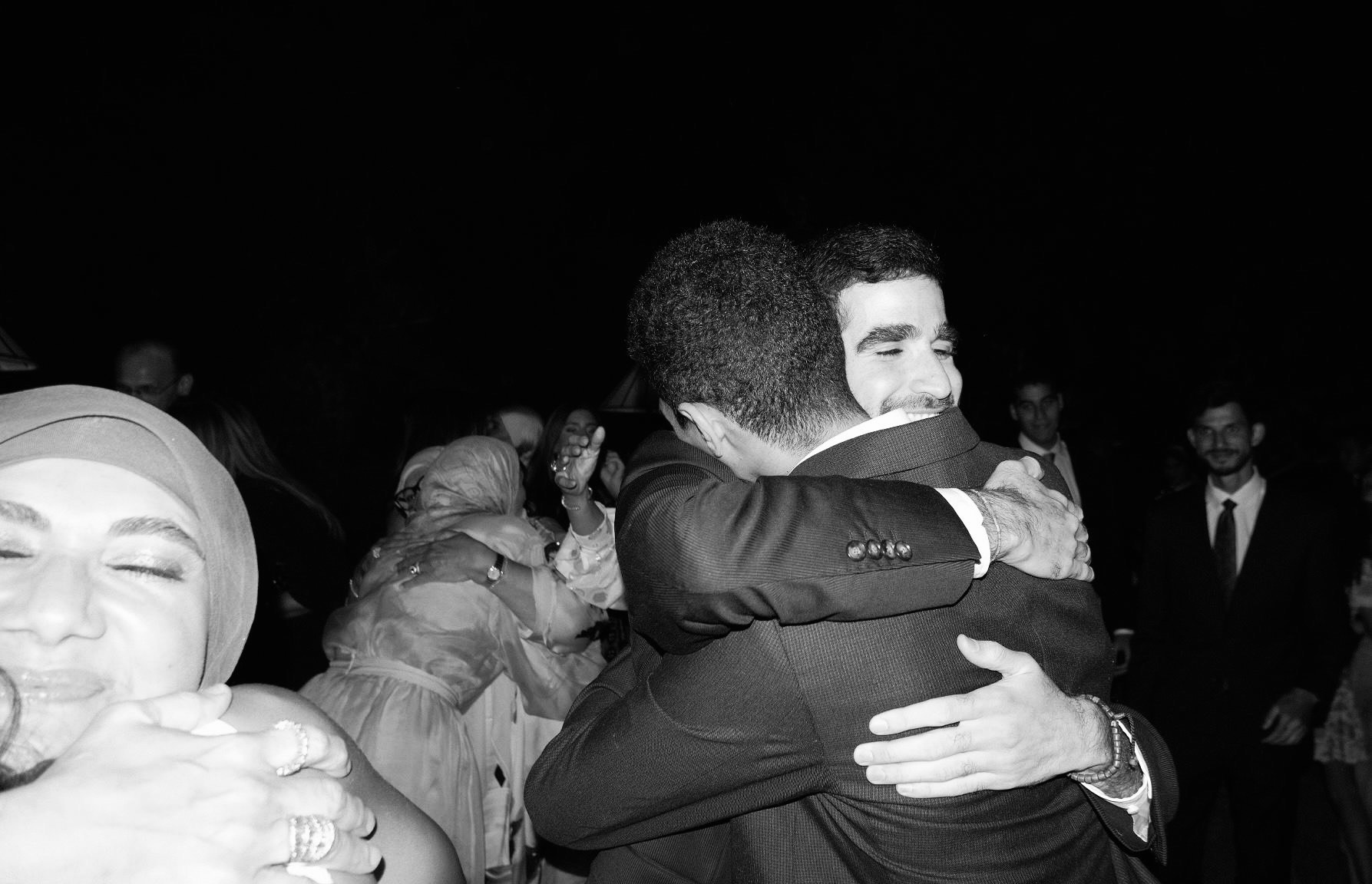
The Arabic word for mercy, rahma, is the same one we use when someone passes. It's also the word I return to during Ramadan, the month of fasting and nightly prayer, when forgiveness becomes something you practice whether or not you can point to a specific sin.
In that month, prayer slows the day down enough to examine it. I ask to be forgiven not for one clear transgression, but for the accumulation of small failures that don’t announce themselves—for the moment I looked away, for the kindness I felt but didn’t act on. Rahma makes room for mercy that doesn’t exile you for being unfinished.
In different families, and in different countries and villages inside the same country, the responses to a sneezer's elhamdulillah vary like dialects of love. They travel by ear, by repetition. You borrow one, keep it, and eventually it belongs to you.
My grandmother Sousou sits at the head of the room in her armchair, her hands folded, the hum of conversation rising and falling around her. She doesn’t move much anymore. When someone says al-hamdulillah, she answers from where she is: yerhamkom Allah w yehdeekom. May God have mercy on you and guide you. The reply comes back differently: yahdeekom Allah w yusliḥ balek. May God guide you and ease your mind. It doesn't widen the blessing. It sends it back where it came from.
My mother moves the opposite way. A woman who has never once let a stranger stay a stranger. The neighbor’s kid ends up fed, the delivery driver ends up seated, the second cousin twice removed ends up staying the whole summer. By the end of it, you’d swear they’d always belonged there. She answers to yerhamak Allah with ghafar Allah lana w lakom. May He forgive us and you. Her mercy is a kind of bookkeeping, forgiveness as a debt you keep current so it never has the chance to slip.
And then there’s my grandfather Gedo Samir’s version. He is the family’s center of gravity, the one the table waits on without knowing it’s waiting. He says yehdeena w yehdeekom. May He guide us and guide you. As if the kindest thing God could hand down was a way forward.
Each phrase carries a kind of surrender. Mercy as breath returning to the body. We say these words asking that God loosen what clenches the heart. It's mercy that gathers us, folds us back into the world, says: you are still here, you are still held.
I think about what “mercy” means in English, and I realize I rarely hear the word at all. When I do, it belongs to institutions—courts, churches, battlefields. A merciful verdict. An act of mercy. It's something the powerful extend downward, something you plead for when you've run out of options. Even its gentlest uses carry the weight of judgment. But rahma is immediate. It's in the kitchen, in the car, in the moments between leaving and staying.
Here, in the U.S., words land on drywall and stop. They don’t wait for an answer.
After a few weeks of Manhattan heat and the overcorrecting air-conditioning of Midtown in July, I can say "bless you" without thinking. No one looks up. I tuck the coin of silence into a drawer and keep typing. I have learned the sound of this new form of belonging—small, clean, dissolving.
On the F train in the mornings, my body learns new rhythms. I stand as if my knees were built for this small sway. The people around me hold their empty coffee cups like talismans. Someone sneezes. “Bless you,” a stranger says, eyes on the door. The train takes a corner like it's remembering how. I raise my hand to my face, feel the familiar lift in my chest that says now, and hold it until the feeling passes. Sometimes even the body misreads its own instructions. I think about what else I've trained myself not to say.
A rhythm is a way of staying. A rhythm is also a way of leaving without anyone noticing.
My uncle, my mom's brother, used to say a healthy body thanks God by expelling what doesn't belong. He loved riddles and stray facts, the kind that made you stop chewing just to listen. He gave me my first real books and could make me laugh until I forgot to be shy.
The Prophet loved the sneeze, he would remind me, because it brings relief. I was eleven or twelve then, still in my stiff school uniform, before I’d learned how to roll the sleeves or knot the belt. Back then I believed everything had a place—dust on the sill, cumin on the air, grief traveling in straight lines between people who spoke to one another in the same words.
Silence becomes a kind of fluency. On campus, in the news, online: some language is watched more closely than others, flattened as soon as it leaves your mouth. It feels both dangerous and indulgent to speak. Dangerous because words can cost more than you intend. Indulgent because silence, too, has a cost, and I am protected enough to afford it. I come from a place of conflict, but not from its most exposed edge.
In the kitchen of my office in Manhattan, the news plays without sound, captions molding themselves into safe shapes. Crisis. Casualties. Complicated. The words smooth the edges until the screen looks like weather. I drink my coffee, stand for half a breath, and learn to step away at the right time. Belonging, I am learning, has as much to do with manners as with belief.
At night, I walk back to the apartment in Midtown, along the blocks that have started to recognize me. The bodega on the corner keeps the bell that chimes too loudly. The man there calls everyone “boss.” Somehow it works as a blessing. I buy bread I will forget to eat and leave with a “take care” that rings truer than most prayers here. I am not sure what to do with the small kindness of the ordinary when the world is on fire on mute.
When I fly home before senior year, my internship over, Egypt is still on the list of countries being considered for Trump's travel ban. My American friends think I'm reckless for going. I do the math anyway; the way you do math on something you’ve already decided. A semester of maybe not returning against a summer of definitely not seeing my grandfather’s hands close around a cup of tea. I don't know how to explain that some risks aren’t really risks, that a place can pull hard enough that reentry stops being the thing you’re protecting. I tell my friends I'd rather risk not getting back into the U.S. than stay away from Egypt a day longer, and I mean it. What I don't say is that I’m testing something too, whether the pull home is stronger than the pull of the life I’m building somewhere else. I already suspect it is. I go anyway.
Past the airport doors, the air is the same as always: hot, unbothered, certain of itself. It isn't a clean smell. It isn't meant to be. West of Cairo, my house sits beside my grandfather's, my uncle's, my aunt's—one family stitched into the same patch of dust.
My mother waits in the living room that always smells of oud and sandalwood. She's sitting with the window behind her—the one that looks out onto the moonlit garden and makes the room glow unevenly, half-shadow, half-silver. She sees me first. The smile arrives before she lets it.
Ezayek? How are you.
Elhamdulillah.
The words settle, closing the space between us more surely than my steps ever could. Her face registers the distance at my edges like a seam that doesn't quite lie flat in the wash. She takes my bag firmly, the way you take a thing that could still run away.
That first night, dinner is at my grandparent’s house—seven p.m., which in Cairo means we're eating early. The whole family is there: aunts, uncles, cousins, the table crowded with bread baskets and noise. My grandfather sneezes. It's small, almost a hiccup. The table stills the way rooms do when they know the next note. Elhamdulillah, he says.
My cousin answers first, quick as a bird: Yerhamkom Allah. My aunt follows, with yerhamkom Allah w yehdeekom. My mother, still reaching for the salt, offers her reply without looking up. Yerhamak Allah.
The blessings move around the table like current, steady and sure, each one finding its place.
I am late. Half a breath. Less than a second but the exact measure of everything I left and everything it took to come back. I feel the pause move around the table, a breeze you can't see. I say it—yerhamkom Allah. My mother puts more rice on my plate, though I'm not finished with what I have.
My grandfather, now smiling, completes the circle with his line: Yehdeena w yehdeekom. May He guide us, and guide you.
Later I climb to the roof, more for the ritual of it than the air. From here, the tops of the trees are the last thing I can make out. Beyond them, everything disappears into darkness. Somewhere in the distance, a dog barks. The low call to prayer drifts across the open land. I listen without answering. Some reverence happens after faith has gone quiet.
I think about what a strong body must throw out, in order to keep going. Dust, infection, air at the wrong time. Signals that once knew to travel from the mouth to another room. If the body is strong when it expels, what does it mean when it holds on?
By the end of August, I am back in Philadelphia, dragging my suitcase up the narrow stairs, the lock stiff where it always sticks. The apartment is exactly where I left it. The plant I asked a friend to water has decided to stay—green still holding, leaves uncurled, as if something had chosen not to give up on me. The cupboard still smells like cinnamon from a jar that broke in April. Small proofs that continuity is not a lie.
The first night I lie awake, still half-tuned to Cairo time, and count the sounds the room knows how to make. Heat clicking through the pipes. A siren that never arrives. My own name, said in my head the way my grandfather says it.
On my walk to class, a woman sneezes and I say “bless you” automatically. She says thank you in that flat, closed-mouth way people use when a stranger holds a door open—half habit, half obligation, already moving on. I think about how many times in a day we make space for one another without meeting. Maybe this is also a kind of blessing. Not the sharp kind. Not the old house kind. But the thin thread that keeps a morning from coming apart.
A blessing means different things depending on which wall it's asked to pass through. Some words are closed doors and some are keys. Some are the breath you push through your teeth, to remind yourself you have a mouth.
As I write this tonight, in Philadelphia, it's early November—the kind of week where the weather can't decide what it wants. The air is warm but the windows fog, and the radiator knocks like someone you're not expecting but are glad to see. I set a cup of black tea by the window and watch the street lamp cut the rain into sharp diagonals. Somewhere above me, a neighbor laughs in a language I don't speak, and I understand perfectly that the joke was good.
It's late when I sneeze—unexpected, almost joyful. It's the kind of sneeze that surprises you into smiling. I say elhamdulillah because the Arabic arrives first, because it still knows the way. I wait for the response without meaning to. The room does what rooms do when no one lives on the other side of the wall—it keeps its silence.
“Bless you,” I say a moment later, a second voice to meet the first. Not translation. Not replacement. Just two hands offering the same small cup.
The tea cools.
On the street, a car passes like a line drawn with the softest pencil.
The night has the manners to keep being night.